
Courage to Reshape the World
Upriver Press Book Review

Brave Companions: Portraits in History
By David McCullough
Simon & Schuster, 1992
In Brave Companions, the masterful writer and historian David McCullough (1933-2022) reminds Americans what courage looks like and what it’s for.
“Those I have written about here nearly all lead lives of active discovery and right to the last,” says McCullough. “They are immensely charged, renewed by what they do. Their work and interests are inspiring forces … With the books they write, their bridges, their breakthroughs in science, the children they raise, their record journeys, the risks they take, they are the givers of civilization” (p. x).
The men and women about whom McCullough writes in Brave Companions were endowed not only with bravery, but also with moral courage. They helped to abolish slavery, built lasting infrastructure, explored the world, advanced science, and established a stronger foundation for future generations.
These men and women lived before our chatbot digital existence. Their work was usually physical, embedded in the harshness and beauty of nature.
Consider Alexander von Humboldt, a German scientist born in 1769. At age thirty, he and doctor-turned-botanist Aime Bonpland set sail for New Granada (now Venezuela) for the purpose of scientific research. They landed there in July 1799 with a theodolite, magnetometer, and rain gauge and proceeded to document everything they saw.
During the first three months, they gathered sixteen hundred plants and identified six hundred new species on the coastal plain. Then they paddled up the Apure River to the Orinoco and other tributaries. For nearly three more months, they rowed against the currents in sweltering heat while fending off mosquitoes and insects, and while avoiding jaguars and snakes. Both contracted typhoid fever, which nearly killed Bonpland.
Then they traveled to Colombia, put a boat into the Magdalena River, and rowed against the current for nearly sixty days until they reached the Andes. They explored there for two years. They climbed Chimborazo, a snow-capped volcano, elevation 20,561 feet.
“They were stopped finally by an impassable ravine,” writes McCullough. “Nauseated by the thin air, they were so dizzy they could barely stand. Their lips and gums were bleeding … The temperature, they found, was three degrees below freezing … The altitude where they stood was 19,286 feet, higher than anyone had ever been before, even in a balloon … Chimborazo would not be climbed for another seventy-eight years” (pp. 12-13).
These men were not merely adventurists seeking an adrenaline rush; they were serving a meaningful purpose to understand and document the natural world. In this way, Humboldt and Bonpland typify the other people portrayed by McCullough: They integrated courage with a desire to serve people and build something good for the future.
In some cases, the men and women depicted in the book directed their courage to help people suffering under systemic oppression, such as slavery. McCullough dedicates a chapter to Harriet Beecher Stowe, who wrote Uncle Tom’s Cabin, a novel depicting the plight of American slaves.
She wrote the book, which played a powerful role in changing Americans’ attitudes about slavery, in a freezing Maine house with holes in her shoes. Harriet said the book came to her in visions. “God wrote it,” she once said. Her purpose was, as her sister-in-law said, “to make this whole nation feel what an accursed thing slavery is” (p. 44).
It worked. To her surprise, the book sold three hundred thousand copies in a year in the US and 1.5 million in England. It was translated into thirty-seven languages. At the end of her life, in 1896, she said this about Uncle Tom’s Cabin: “Nobody expected anything, and so I wrote freely” (p. 51).
However, as the book’s influence spread, slaveowners began to threaten Harriet and her family. They labeled her as a “radical.” They sent death threats. Someone sent her a black man’s ear (p. 46). Despite these threats, she and her husband, a minister, continued their efforts to free the slaves.
McCullough also reveals the courage of laborers who never gained fame or fortune, including thousands of immigrants. They worked in dangerous jobs for minimal pay. They did so for one reason: to provide for their families and give their kids a better life. One chapter focuses on the workers who in the 1850s came from around the world to build a railway across the isthmus of Panama (before the canal was built).
McCullough shares the following account of the abysmal conditions. “In the black, slimy mud alligators and other reptiles abounded; while the air was laden with pestilential vapors, and swarming with sandflies and mosquitoes” (p. 93). The workers made slow progress inland by bridging miles of swamp. Lumber rotted. Chagres fever, a type of malaria, sickened or killed many men. If that disease didn’t take them out, dysentery, sunstroke, cholera, and yellow jack killed many more. McCullough reports that an estimated six thousand men in all died.
Miraculously, perhaps, the surviving workers managed to complete the job, extending the railway from shore to shore. Investors in Boston and New York, who never shared in the workers’ suffering, celebrated as share prices soared by as high as 44 percent (p. 102). By 1904, however, the railway had been abandoned and left in disarray. The Panama Canal, the building of which killed at least twenty-thousand men, rendered the railway obsolete.
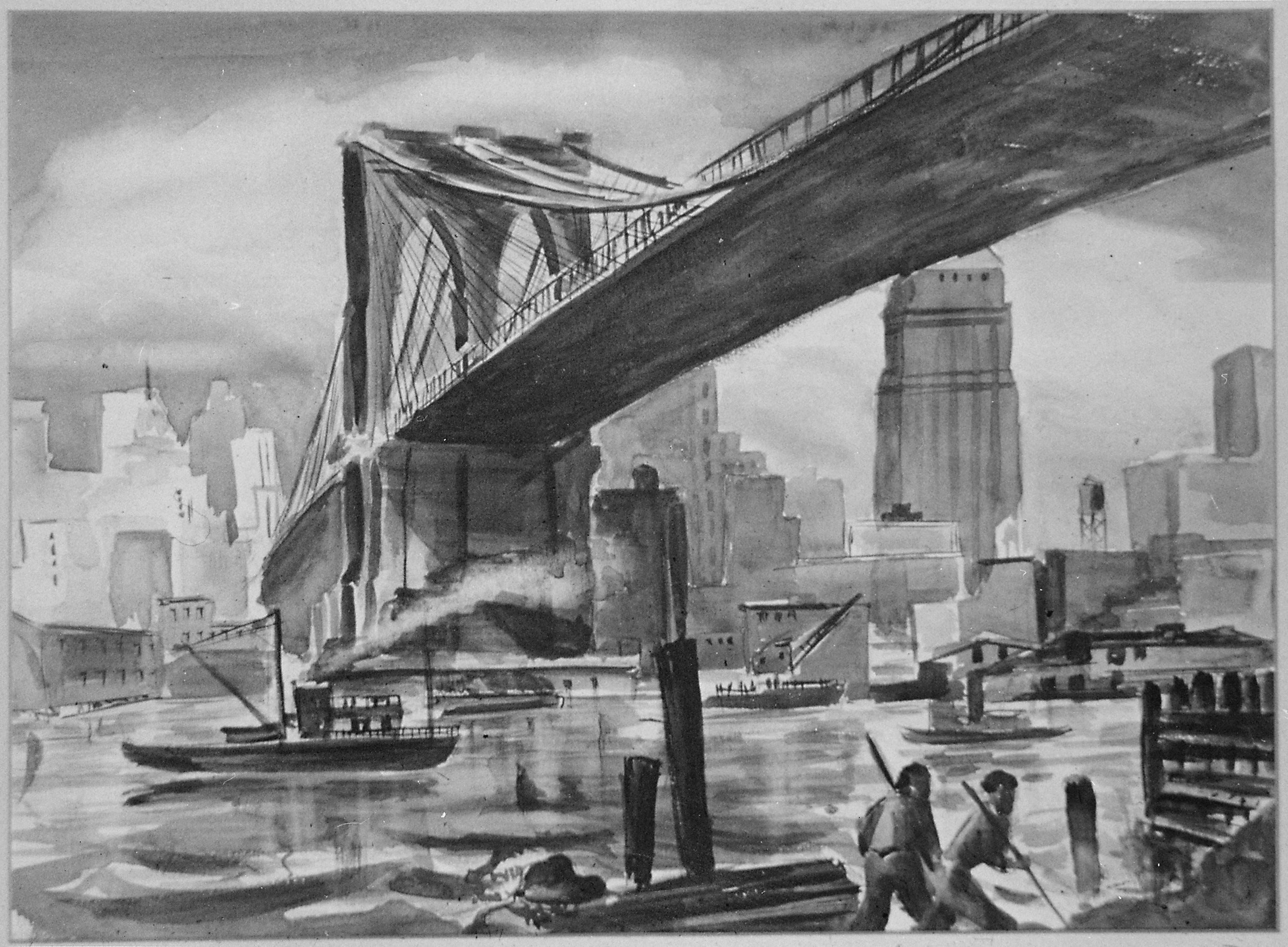
McCullough elevates the courage of the laborers and engineers who built the Brooklyn Bridge: “the stonemasons, carpenters, riggers, machinists, blacksmiths, riveters, and all the ordinary day laborers who went into the terrifying caissons beneath the river for the bonanza wages of two dollars a day” (p. 106).
Caissons, positioned deep underwater for the purpose of building the bridge’s foundations were “colossal, bottomless wooden boxes filled with compressed air, to keep the river out, and held in position on the riverbed by the tower being built on top,” writes McCullough. “Inside the box were a hundred men or more digging away with picks and shovels.”
As the men dug, by candlelight, the box was forced deeper until it rested on bedrock. One caught fire, burning for twenty hours. Men who escaped went into the cold water and came up so fast that they got the bends (p. 111). Fire was not the only threat. Many others died by falling, drowning, or being crushed by steel rigging and stones.
The world we live in today was constructed by brave, noble men and women like those described in McCullough’s excellent book. Most were motivated by the high calling of loving their families, working hard with integrity, supporting their workmates. Collectively, they made the world better.
Reading the book will raise an important question: What type of world are we building for the next generations?
Quote to Ponder
“AI is less regulated in America than sandwiches. You can’t open a sandwich shop without having your kitchen inspected. But you can release an AI girlfriend for 11-year-old boys and that’s fine.” — Max Tegmark, MIT physics professor
Excelente